Thursday, February 14, 2013

Marmot Nabu Neoshell Softshell Highlight

Part of this article was already posted.  This is the rest of it.

One of the most searched Marmot products in the past year has been the Zion jacket, according to the local Marmot sales rep.  That doesn't surprise me.  In a short time after posting Phil's review of the Zion jacket on this blog, it moved up to the second most read review and is still there.  We have been quite impressed with the Zion Jacket over the last year or so, but as was stated in the review, it isn't perfect.  The best part of the jacket is the Neoshell in a softshell application.  It breathes very well without the cool feeling that tends to accompany Neoshell hardshells.  The downside of the jacket is that it's on the heavy side and it is quite warm, making it a little less versatile during the warmer months.

When I saw the Marmot Nabu jacket at summer OR in July, I couldn't wait to get my hands on it.  It seemed to me like they took mine and Phil's complaints about the Zion jacket , fixed them, and called it the Nabu.  I am happy to say that the Nabu jacket showed up at GEAR:30 last week, one of the few placed around that have them this early.

*I haven't been able to use it yet, but from trying it on and checking it out in the store, I have not been disappointed.  I think this could be the ideal foul weather active piece for the whole year.

So, here are some pictures and descriptions of the jacket, as well as some specs.

Nabu Specs

  • Weight: 21.6oz (Men's Medium).  In comparison, the Zion weighs 26oz in size Medium
  • 2 handwarmer Pockets
  • 1 external zip chest pocket
  • 1 internal zip pocket with headphone port
  • Adjustable cuffs
  • Adjustable, helmet-compatible hood (truly helmet-compatible, unlike the current Zion)
  • Drawcord hem
  • Lightly insulated

Pictures and Descriptions

The Men's Marmot Nabu Jacket.  If you like the Zion, I'm pretty sure you'll love the Nabu.  If you didn't like the Zion, I'm pretty sure you'll like the Nabu.

The women's color.  A vibrant red with blue zippers.  It's a really nice color combination, in my opinion.  So far we've had only good feedback from women on the color and fit of this jacket.


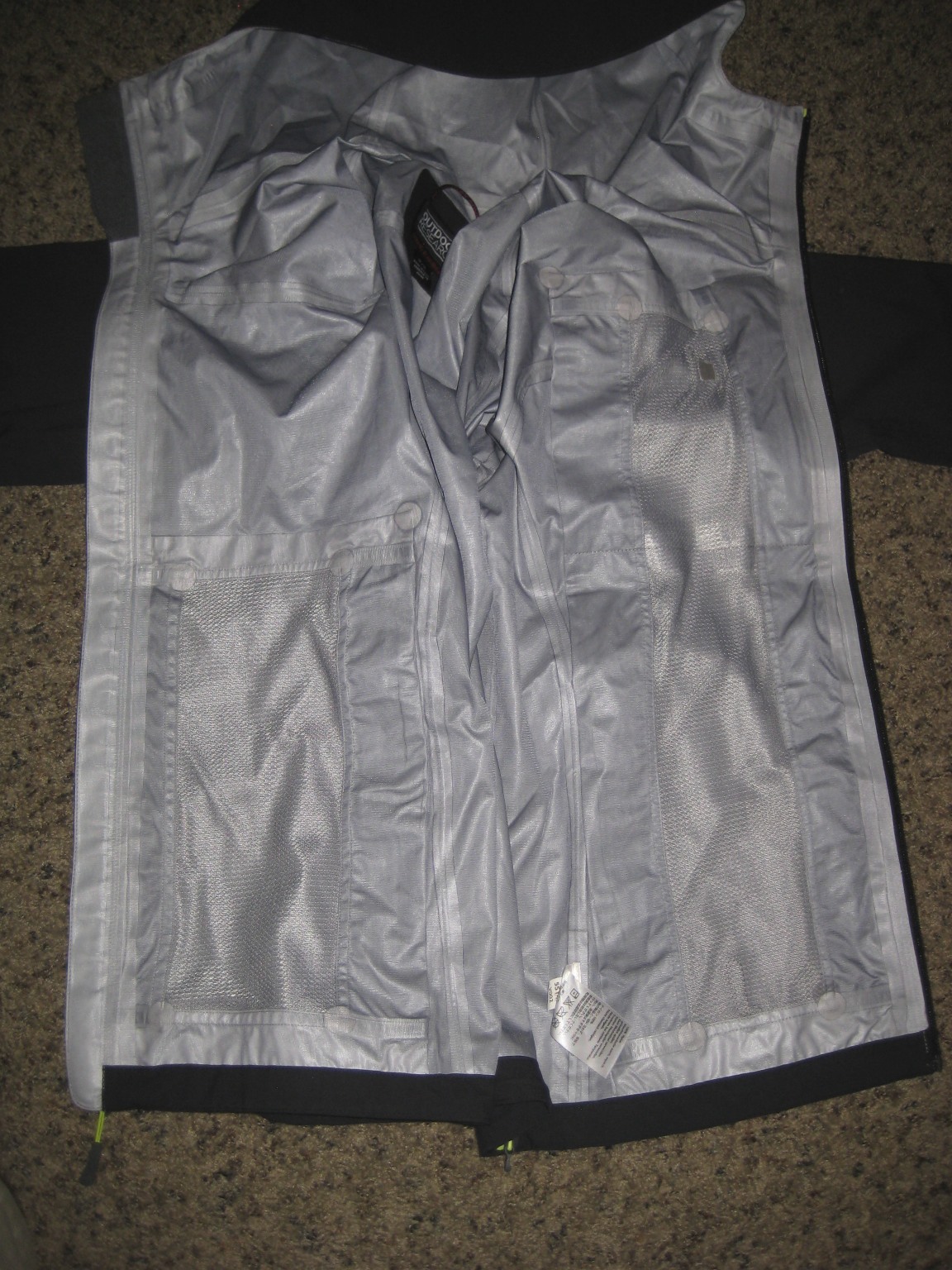
Not sure what happened to the color on this picture, but it is actually the same jacket as above, just a little washed out.  Anyway, there is a single zippered interior pocket on the inside.  It is big enough for a smart phone, wallet, etc.   Taped seams, Neoshell, and the light grid-mesh liner (which help to wick moisture) make this one of the most breathable, fully waterproof jackets on the market.  This used a similar application as Marmot did on the Zion jacket, but used a lighter interior liner fabric and exterior face fabric, which I can only imagine make the jacket more breathable, lighter, but probably less warm.


Detail of the interior grid mesh material.  At first I was calling it a really light grid-fleece liner, but it doesn't really feel much like fleece.  It goes over layers better than fleece, but also isn't quite as soft as fleece.  I think calling it a mesh is more accurate.

Polartec Neoshell in a softshell application.  Neoshell is incredible as a waterproof membrane.  It breathes far better than any other membrane I've used to date.  The downside is that, in a hardshell application, it moves humid air away from the body so efficiently that it can feel a little colder than other waterproof/windproof shells.  Not as ideal to wear while sitting on a cold ski lift.  For example, when I wear a Gore-tex shell, I can plan on the shell adding about 10 degrees of warmth to my layering system, at least until I get sweaty.  And unless I'm cold all day, I almost always get sweaty in Gore-tex.  With Neoshell, it doesn't trap much heat.  When I wear a Neoshell hardshell, I don't plan on it adding any warmth to my layering system, so I dress accordingly.  But I also expect that, if I've dressed correctly for the conditions, I either won't get sweaty during the day, or I'll dry off fairly quickly while still wearing my shell.

In softshell application, I and Phil have found that it breathes even better than in the hardshell (because the liner wicks moisture, I'd imagine), but it doesn't feel as cool as in a hardshell.  You don't get a slight chill when you're resting at the bottom of a frozen waterfall after a 45 minute approach, like you do in the hardshell.  It is just comfortable.  I think that the Neoshell softshell application is the best performing waterproof material so far.

The hood has an aperture drawcord the pulls the hood tight around the face.  The rest of the cord remains on the inside of the jacket.  Though this is clean and keeps the cord from smacking you in the face in high winds, it forces you to unzip the jacket tighten the hood. 


There is a second drawcord at the back of the hood that takes extra volume out of the hood and allows the hood to move with your head.  This hood can actually be worn with a helmet.  More on that in a minute.

I am 6'2", 190 lbs or so, and this is a Medium.  The Medium fits trim with little extra room to layer, but it is still a comfortable fit.  The large was a little roomier and allowed room to layer, but didn't seem too baggy.  I usually go for the trimmer fitting layers, but in this case, I liked the Large better for my size.  I think the medium would be a better fit for those that are under 175-180 lbs or so or you prefer a trimmer fit.  The face fabric on the Nabu is not as stiff as on the Zion, so the medium Nabu is a much more comfortable fit, in my opinion, than the medium Zion.

The hood fits nicely without a helmet.

The hood also fits nicely with a helmet.  The Zion jacket's hood was not quite big enough for a helmet, in my opinion.  When you zip the Zion up with a helmet on, the fabric is super tight across the mouth.  The Nabu has a little more room and is comfortable to wear zipped up with the hood over a helmet.

The hem still pulls up a bit with arms up, but not enough to pull out of a harness.  The cut isn't as good for climbing as the Rab jackets I've used, but it is a little more comfortable cut, especially under the armpits, than the Rab.  The only place I think the cut is a downer is when climbing.  Unfortunately, that's exactly what I want this jacket for.  

The jacket has a drop hem in the back.  The sleeves are a comfortable length on me (I have pretty average arms).  For those that have longer-than-normal arms, the sleeve length may be a little frustrating when climbing in the jacket.  For most people, the length should be fine.

There is great stretch in this jacket.  Because of the stretch and the softer face fabric, it is a very comfortable jacket to move in.  It feels less restricting than the Zion.  It also feels significantly lighter than the Zion.  Even though it is only 4.5oz lighter than the Zion, it feel to me like it's much lighter.  I think that is because the face fabric is thinner and more supple and the wearer has to put in less effort to move in it than the Zion.

More stretch.


Final Observations

Both Phil and I have been very impressed with the Zion jacket, but mostly with the softshell Neoshell fabric.  The jacket itself, needs some work.  Marmot told me that the hood is being revamped on the Zion jacket to better accommodate a helmet.  That's definitely a much needed update.  But there were multiple gripes that we had with the Zion jacket that we felt needed to be addressed.  To review, here they are:

  • Hood to small/jacket too trim around the mouth
  • Fabric too heavy
  • Jacket too warm for shoulder seasons and warmer winter days
  • Too many pockets (interior pockets, many exterior pockets, a shoulder pocket, etc)
  • Medium fit well in the body but pulled up out of a harness when lifting hands above the head


I think the Marmot Nabu remedies all of these problems, except maybe the jacket pulling up too much when lifting hands above the head.  

The hood is much better than on the Zion.  

The fabric is lighter and more supple, making the jacket feel much lighter than the Zion, even though there's only a 4.5oz difference.  

The grid-mesh liner fabric is much lighter than the fleece used in the Zion jacket, making the jacket less warm (which I consider a good thing, though many may disagree with me on that).  The fact that this jacket is less warm means it's a better 4-season jacket, instead of a cold weather only jacket that I feel the Zion is.

There are less pockets on the Nabu.  Only one less, but that's a start.  They got rid of the arm pocket that is on the Zion.  I like the pockets that are on the Nabu.  They make it a more versatile jacket.  If I was designing the perfect climbing jacket, I would have taken off even more pockets, but the pocket configuration on the Nabu are fine.  They're out of the way of a harness/hipbelt, so I'm happy.

The jacket doesn't come untucked out of a harness when I lift my arms.  This is true about both medium and large sizes.  It does pull up a little and then bellow out over the harness a bit, but most of my jackets do.  This cut is as good for climbing as most any I have tried, Rab and Arc'teryx not included.

Overall I am super impressed with the jacket.  I haven't used it yet in the mountains, so my mind could very well be changed in the coming months, but so far I think it could be one of the best active jackets on the market.

Wednesday, February 6, 2013

Citizen Series Skimo Race

Last night I had the opportunity to participate in one of the Citizen Series skimo races that are put on by some Salt Lake skimo guys.  I've read about them for a long time on various blogs (Andy Dorais, Jason Dorais', Jared Inouye's, etc) and have been wanting to participate, but a busy schedule with work and family have kept me from going until yesterday.

The format was a team sprint relay, with two people per team making 3-4 laps each.  One lap consisted of two climbs (probably about 3-400 vertical feet each or so), a booter section, and 3 transitions.  This was my first taste of skimo "racing", so I wasn't sure what to expect, but it was an absolute blast.  The casual atmosphere was comfortable to a newby like myself, everybody was friendly, and it was good to get my heart rate up in the clean air with other like-minded people.

I didn't get any pictures of the event, but for all those that enjoy being fit and skiing/ski touring, I highly suggest checking out these races.  They are free, fun, there's swag for first-timers, and pies for the winners.  It's worth the drive up to Brighton ski resort, even for those whose drive is a bit longer, like myself.

I can't wait til the next race on the 19th.

For more info on these races, check out:

http://citizenseries.wasatchpowderkeg.com

Wednesday, January 30, 2013

Marmot Nabu Jacket Review/Preview


Women's Marmot Nabu Jacket

One of the most searched Marmot products in the past year has been the Zion jacket, according to the local Marmot sales rep.  That doesn't surprise me.  In a short time after posting Phil's review of the Zion jacket on this blog, it moved up to the second most read review and is still there.  We have been quite impressed with the Zion Jacket over the last year or so, but as was stated in the review, it isn't perfect.  The best part of the jacket is the Neoshell in a softshell application.  It breathes very well without the cool feeling that tends to accompany Neoshell hardshells.  The downside of the jacket is that it's on the heavy side and it is quite warm, making it a little less versatile during the warmer months.

When I saw the Marmot Nabu jacket at summer OR in July, I couldn't wait to get my hands on it.  It seemed to me like they took mine and Phil's complaints about the Zion jacket , fixed them, and called it the Nabu.  I am happy to say that the Nabu jacket showed up at GEAR:30 last week, one of the few placed around that have them this early.

*I haven't been able to use it yet, but from trying it on and checking it out in the store, I have not been disappointed.  I think this could be the ideal foul weather active piece for the whole year.

The rest of this Preview/Review/Article can be found here:

http://www.gearthirty.com/blog/2013/01/31/marmot-nabu-neoshell-jacket-preview/


Updates on the performance of this jacket will come as I get to use this jacket a bit.  Stay tuned.

Saturday, January 5, 2013

Arc'teryx Quintic 28 Backpack Review

My backcountry backpack for the last few years has been a 40 liter winter pack that could carry anything from skis to ice tools to snowshoes to the kitchen sink.  Unfortunately, to do so necessitated lots and lots of straps.  It was a fine pack as a do-everything winter pack, but I really only used it as a ski pack, so it was a little too complicated.  I wanted something a little simpler, sleeker, and smaller.

When the Quintic was first released, I impulsively ordered one.  I ordered it for a few reasons.  First of all, it is a unique design.  The shape of the pack and the unique pockets piqued my interest.  The second reason was, unfortunately, the brand.  I have had good experiences with most of the Arc'teryx pieces I have tried.  They are generally clean, sleek, and functional.  The third reason was that I had access to a discount on that pack.  I pulled the trigger and this is what I have found, so far.

Stats and Features

From Arc'teryx's Website:
Designed for everyday use, this 28 litre pack is a steadfast partner for backcountry and close-to-area tours and features a lowered, wide, flat body of the pack that is shaped to the contours of the lumbar vertebrae and that holds and transfers the pack’s load through the body’s centre of gravity. Stable support and with easy access to items in the main compartment while in transit, this is a skier’s/snowboarder’s tool kit. Separate compartments keep shovel, safety gear, food and extras balanced and organized, and a reinforced, external wrap system is robust enough to carry skis and boards (A-frame, split and diagonal carry of skis; horizontal and vertical carry for snowboard). This pack is large enough to accommodate all your necessities for day tours.

Construction
            Top grab handle
            Supportive framesheet
Zippers & Fly Configuration
            Webbing zipper pulls
Pack Pocket Configuration
            Front pocket with internal organizational pocket and key clip
            Secondary storage compartment with external side zipper access, and alternative access from inside the main compartment
            Panel loading main compartment with front U-zip access and organizational slots
            Internal zippered pocket inside side-access secondary storage compartment
            Top pocket with internal security pocket stores skins or goggles
            Water bottle pocket

Pack Hydration
            Hose clip
            HydroPort™
            Internal hydration pocket with zip
Pack Suspension Configuration
            Webbing hipbelt
            Adjustable, removable sternum strap
            Laminated shoulder straps
            Breathable backpanel
            Removable framesheet contained inside an anatomically patterned sleeve that conforms to the curve of the back when fully loaded
Pack Loading & Closure Configuration
            Panel loading
            Side access to main compartment during transit

Weight: 35oz (short torso 26L); 42oz (Reg Torso 28L); 49oz (Tall torso 30L) 


Pictures and Explanations

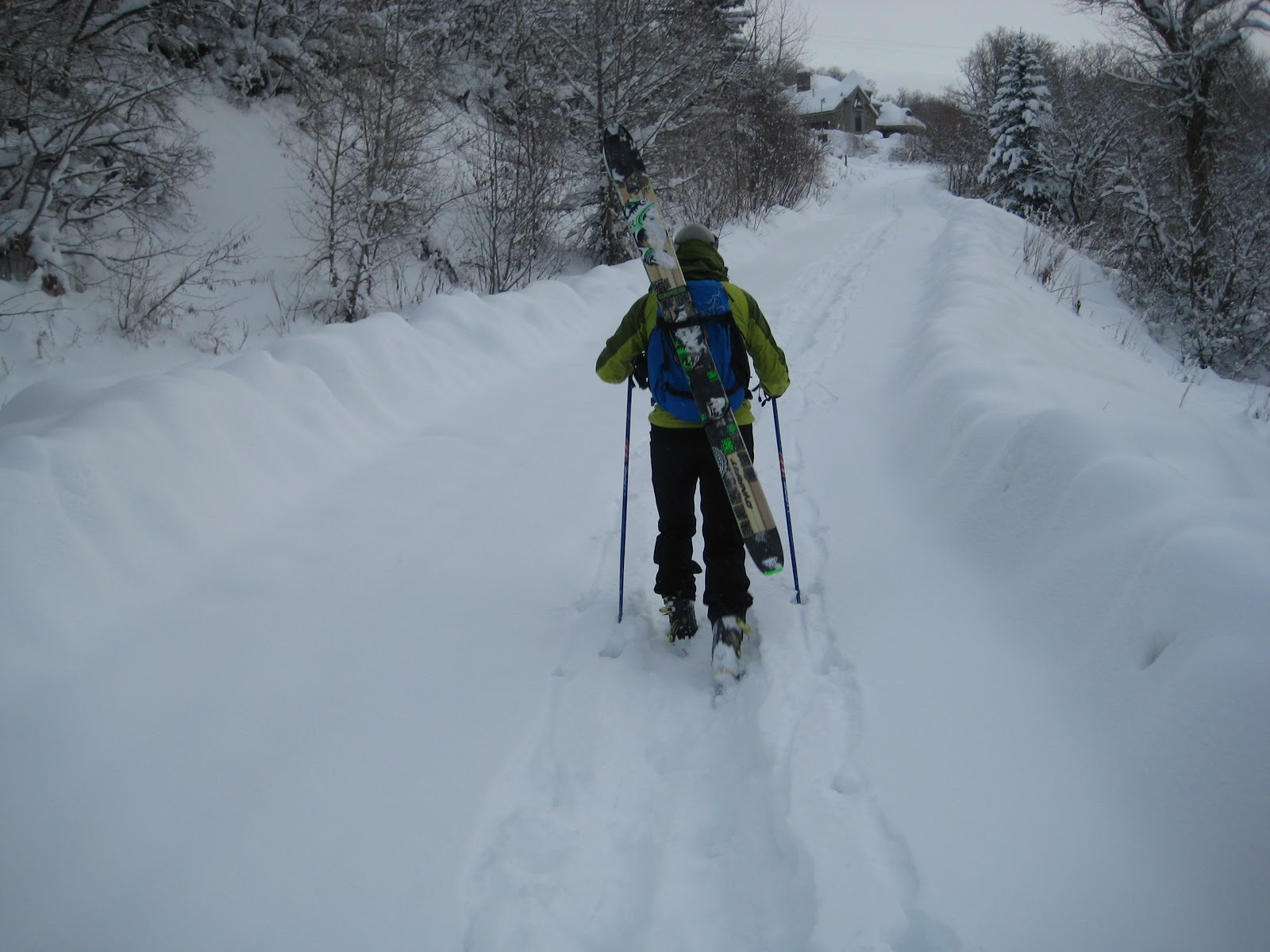
Hiking the last 100 yards back to the truck at the end of a good day

The Arc'teryx Quintic 28

The left lower pocket of the pack is designed to carry a water bottle.  It is large enough, albeit tight, for two 1-liter nalgenes.  This pocket is located on the left hip so that it's easy to reach on the go.  I find that it's much easier to pull the bottle out than to get it back in.  I carry a 1-liter nalgene with a warm drink and all my energy gels/chomps/etc so they don't freeze. 

The right side lower pocket is the zipper to access the main compartment.  The compartment is large enough for gloves, a jacket or two, and whatever else you may want in the backcountry.  It's also large enough for a lightweight skimo race helmet, but not large enough for a normal ski helmet.   The zipper is a little on the small side, making it a slightly more difficult to get to the contents of the pack.  It's not a big deal unless you're trying to get a large item out of a full pack.  Where the two side zippers are located, it would be pretty difficult to get into the pack through most any pocket if the skis are being carried A-frame.  For this reason, I like packs with access through the backpanel. 

Within the inside of the main compartment is a zippered pocket.  This pocket is easily big enough for a pair of gloves and a water bottle.  I rarely use this pocket, except maybe to keep a wallet and car keys so they don't accidentally fall out.  


There are three zipper pockets on the top of the pack.  The pocket closest to the face of the pack is large enough for goggles and has a key clip and a small internal pocket.

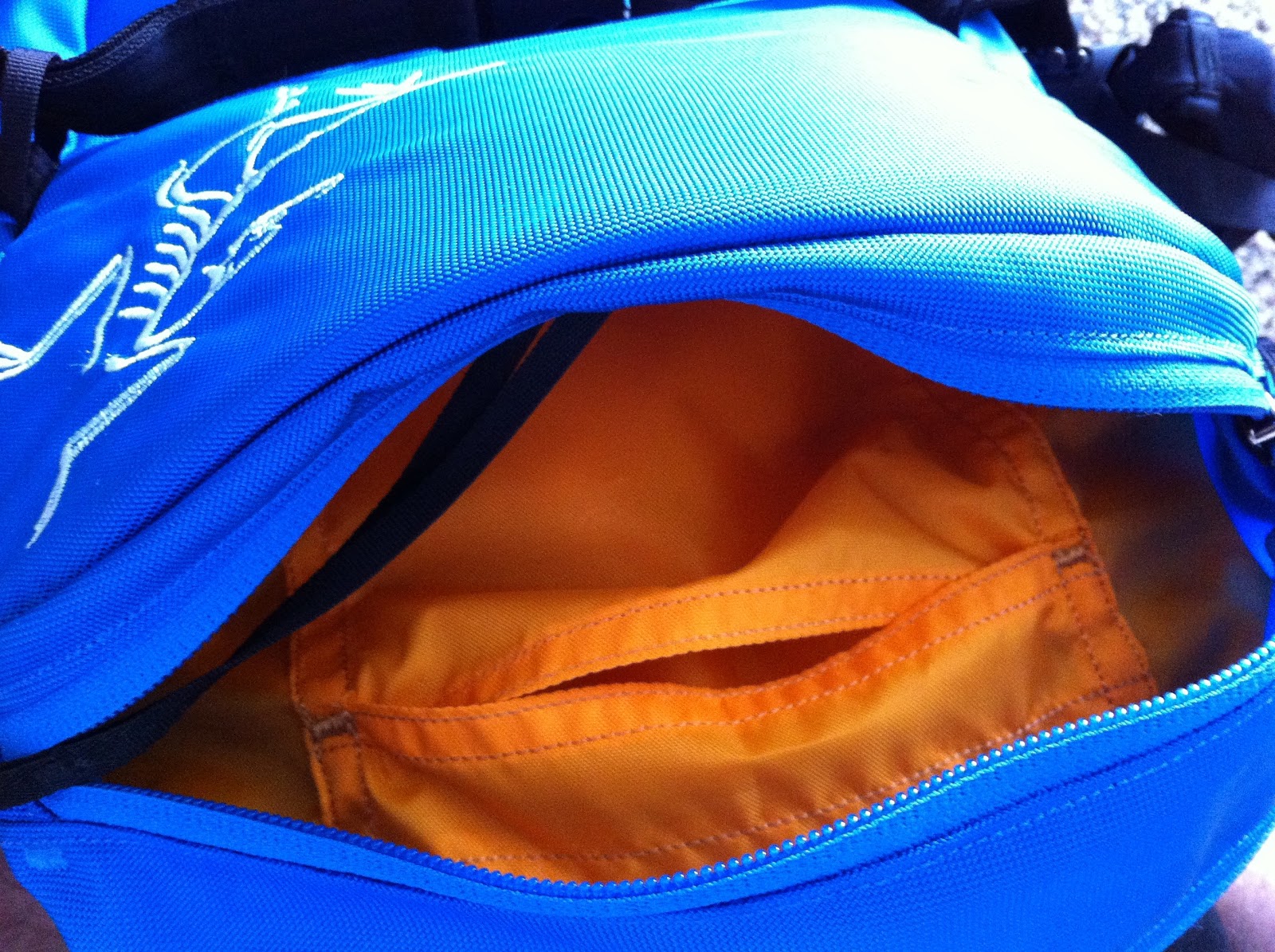
Within the goggle pocket is a smaller pocket, not zippered.  I'm not sure what the pocket is for, but why not.  There are so many pockets within other pockets in this pack that most of them go unused.

The second zipper accessed from the top is for avy tools.  It's large enough for a shovel, probe, saw, and skins.  It folds wide open for easy access to tools.

As with most backcountry packs, the tool pocket has storage slots.  It is pretty easy to rip open this pocket to get to tools, but the zipper pulls blend in with all the others.  I haven't done it yet, but when every second counts, a little colored shrink wrap over the zipper pulls may help identify the tool pocket.

The third zipper accessed from the top is for whatever else you need.  It is large enough for gloves or whatever else of similar size.

The zippered pocket within the zippered pocket on this one is made of soft mesh.  It is a good pocket for a smartphone or anything else you don't want scratched.  Within this pocket is another zippered pocket.  Just kidding.

In this same third top pocket the bottom of the pocket can be detached so that you can access the main pocket from this top pocket or from the right side zipper.
The bottom fabric of the pocket detached where my pointer finger is.   It attaches/detaches with velcro.


The pack is shaped like a teardrop.  The wider, lower part of the pack fits in the small of the back and wraps around the body comfortably.  When snugged up tight with the hipbelt, it rides real nicely.  Whenever I ski, the pack doesn't move.  It doesn't even feel like I'm wearing a pack.

The webbing straps can be configured to carry skis A-frame or as a diagonal carry.  It will also carry a snowboard in both an up and down and a wide configuration.

When carrying skis A-frame, the lower webbing strap can be attached to the hipbelt

Just above the shoulder straps is a port for a hydration tube or headphones.  This port is accessed from the top pocket.

I retrofitted an avalung to the shoulder strap of the pack.  I don't like wearing a beacon, an avalung, and a backpack.  It gets a little congested.  The avalung on the shoulder strap cleans it up a little, but it's still not as clean as a BD avalung pack.

The avalung is held on with zip ties.  I hope that's enough in an avalanche.  I've never been in an avalanche before, so I don't know how well the avalung or the zip ties would handle it, but I like the arrangement so far.

The pack carrying skis diagonally.  The pack carries the skis pretty well, bit it feels like the skis pull away from the pack a little.  I think if there was an attachment from the shoulder strap to the skis it would carry better.  The skis wouldn't pull away as much from the pack.

The Verdict

I am a huge fan of this backpack for many reasons.  First of all, it is well made, just like all Arc'teryx pieces.  The materials used in the pack are superb.  Second, the features, pockets, and strap configurations are innovative and work well.  Finally, I love the shape of the pack.  It rides better than any other pack I have ever worn skiing.  It really is an incredible fit for skiing.

As far as a backcountry skiing pack, I think the Quintic is a great pack with a great design.  As far as a ski mountaineering pack goes, it wasn't designed as such.  It's not designed to carry an ice axe, for example.  

I am very happy with this pack for most of the skiing I do.  For spring ski mountaineering in the Tetons, for example, it may not be my go-to pack.  But for 90% of the skiing I'll do in the Wasatch, I'll be wearing it.

I would give this pack 4.5 out of 5 stars.  The only complaints I have so far is that the zipper to the main compartment is a little small so it can be a little difficult get to your gear.  Second, the diagonal ski carry system works pretty well, but not perfect.  As I mentioned before, in my opinion, an attachment from the shoulder strap would be better.  Other than those things, I really like the pack.   In my opinion, if you want a good backcountry ski pack that fits well for the downhill, this one is great.  If you want a ski mountaineering pack, there are better options.


Wednesday, January 2, 2013

Cutler Ridge and Ben Lomond

After a nice Christmas storm dropped a couple feet of snow on the local peaks, a little bit of backcountry skiing was in order.  The snow was deep and mostly untouched.  I took some pictures and video, but they don't do it justice.  Here's a little clip.  It's poorly made because it is my first attempt at using iMovie, but it's something.


I was skiing with my father-in-law who is learning to ski powder.  He's never really skied powder before, so he was looking pretty good for a first timer.

I apologize for the poor ski footage.  I was using a digital point-and-shoot held in my hand.  I didn't realize until I got home that most of the footage I got was of the sky and the top of the trees.


Tuesday, January 1, 2013

My Resolution for the New Year

I want to briefly wish everyone a Happy New Year!  This year has been a great one for me.  In addition to starting this blog, I have been fortunate enough to open a climbing/bc skiing/backpacking/trail running/whitewater paddling shop with a few friends; climb, ski, trail run, and backpack all year long with great friends and family without any injuries or major epics; met a lot of new people and gained many new friends; and graduated from college.

I have enjoyed the past year, but I have a good feeling that this next year will be the best yet.  A few things I have to look forward to are a business that will (hopefully) continue to gain traction; great skiing, climbing, running, etc in the mountain ranges of Wyoming, Idaho, and Utah. . . especially Ogden; and most importantly, our first child will be born in March.

Each year at the new year I contemplate whether I wisely took advantage of the time I had in the previous year.  This leads to memories of climbing trips, biking, skiing in incredible locales, beautiful runs in the mountains, etc.  But the greatest memories are about the people that I spent time with while doing these activities.

I also use this time to set goals for personal progress for the coming year (as I know many other people do as well).  In the past, my goals have often been selfish.  Things like training and racing in a particular mountain marathon, training and completing a certain bike race within a certain time, climbing a particular grade of rock climb, or doing a winter ascent of a technical route on a mountain.  These are all goals that push me to better myself in a certain way, but they are all selfish goals.  Though I work hard to complete them and feel satisfaction when I reach the goal, that happiness is fleeting.  Now, don't get me wrong, I don't think these types of goals are bad.  They serve their purpose by helping me achieve a higher level of personal performance than I would have otherwise attained.  But when I look back at the most enjoyable times of the year, the highlights almost always include friends and family and have little to do with the initial goal.

I am writing this post more as a reminder for myself than for anybody else.  I have been contemplating how having a child will change my life and what kind of a father and husband I would like to be.  I have seen how some friends' and acquantances' good goals have gotten in the way of more important goals; how an obsession with mountains and exercise have strained a marriage and family relationships.

I am reminded of something I heard a few years ago.  In a speech about priorities, the speaker said,

"We have to forego some good things in order to choose others that are better or best."

The principle is simple to understand, but harder to put into practice, especially when the good things are more fun than the better or best things.  So, with all of this said, here is my resolution:

Do not let personal (selfish) goals compromise quality family time and activities.

A key to setting and achieving goals is to make them measurable and realistic.  I don't think this resolution passes either of these tests.  Without a little more clarification of what "quality family time and activities" and what "personal goals" are, it is hardly measurable.  And to believe that going out and spending time in the mountains away from family will not negatively affect family time and activities is naive at best.  So to achieve this goal to perfection is not likely.  But, what I'm hoping this resolution will do is remind me to err on the side of family time and quality relationships, and not chase personal (selfish) goals that have little or no lasting value at their expense.

This does not mean I will stop playing in the mountains.  This does not mean I will stop setting selfish personal goals that only benefit me.  This hopefully means that I will remember the proper place for these goals: in the "Good" column, under the "Better" and the "Best" columns.


Monday, December 10, 2012

Why I've Stopped Tying in with a Bowline

Here's a link to a story about John Long getting injured at a gym when his bowline came untied and he fell.

http://www.rockandice.com/news/2383-john-long-injured-in-groundfall

John says the knot failed because he didn't finish tying it properly.  I used to tie in with a bowline because they are easier to untie.  I no longer do because a friend of mine was 50 feet up a 5.12 trad lead, noticed his bowline had come untied and wouldn't hold a fall, had to re-tie the knot with one hand while barely hanging on with the other, and then lowered to safety.  I know it's a safe knot when done correctly, but that is two people I know of that are much better, harder, and more experienced climbers than I am that have narrowly escaped disaster because of a bowline coming loose.

I've decided to just stick with a figure eight.  It's never come loose on me, and trying to untie one after a hard fall just gives my arms a better workout.  Nothing wrong with that.

Thursday, December 6, 2012

Early AM Trail Runs and the New Store

It's been a long time since I have written anything on this blog.  There are a few reasons for that.

First of all, we finally opened the new store (albeit in a temporary space).  It's been really fun to work  on opening a business over the last year or so.  I have learned a ton, met a lot of great people along the way, and am excited about what the future holds.  With that said, most of my time has been spent at the store and not in the mountains.

Second, because of the lack of free time during the days, my workouts/adventures have been taking place between about 4 and 6am.  The majority of workouts lately have been trail runs, but we've thrown in some dry tooling and rock climbing as we anxiously await colder temperatures.  Unfortunately, I rarely remember to bring a camera on my runs, and the camera on my phone takes horrible pictures (and doesn't have a flash for pictures when it's dark).  Therefore, when I don't have pictures, I don't blog.  It's just so much easier to download a picture than think of something interesting to say.

Anyway, here are a couple links to some of the press that our store has been getting recently.  We're pretty excited about it.

This from the Standard Examiner.  We appreciate the article and the Standard's support.

http://www.standard.net/stories/2012/11/28/gear30-opens-ogden-riverbend-project-area

This from KUTV's morning show.  Brandon, our marketing director, with Ron Bird:

http://www.kutv.com/news/features/guests/stories/vid_882.shtml

For all those in or near the Ogden area, come check us out.  We'd love to see you.  Our address is
1931 Washington Blvd., Ogden, UT 84401.  We will have a big grand opening party in January, once we are in our permanent space, and everybody is invited.  More information about that still to come.

And join us on facebook at https://www.facebook.com/GearThirty and online at www.gearthirty.com


Saturday, November 10, 2012

Outdoor Research Axiom Jacket


The next jacket is the Outdoor Research Axiom.  This jacket won Gear of the Year awards from both Outside Magazine and National Geographic Adventure for 2012 and did so because it is a great, all around jacket.  I have not had the opportunity to use this jacket yet.  For a review from somebody who has used the jacket, check out:

http://theadventureblog.blogspot.com/2012/06/gear-closet-outdoor-research-axiom.html

I just hope to share my observations based on fit and features.  This can be dangerous because I have a few pieces of gear that did not impress me too much initially, but after using them, they have become some of my favorite pieces.  There are other pieces that I own that I was really excited about initially, but have become closet fillers only because in use, they're just not as good as I was expecting.

So, use this post to get an idea of what the jacket offers for features, and get a slightly better idea of how it fits, and then check some other reviews for an idea of how the material breathes and the jacket functions.  From everything I've read, the jacket works great in real-mountain applications.

Specs and Features

  • Made with Gore-tex Active Shell membrane and 20d nylon stretch face fabric
  • One zippered external chest pocket, backed with mesh, with a headphone port
  • Two zippered handwarmer pockets that are just high enough to stay out of the way of a harness and backed with mesh for additional breathability
  • Single-pull adjustable hood
  • Velcro cuff closures
  • Single-pull hem drawcord
  • 13.5 oz

Pictures

The Outdoor Research Axiom Jacket in Black/Lemongrass Color

Has one chest zippered pocket that is backed with mesh.  The pocket is actually larger than the yellow outline. 

Two zippered handwarmer pockets that are high enough that they mostly stay out of the way of a harness and hipbelt.  These too are backed with mesh, which would allow one to dry damp items like gloves, or vent a little when working up a sweat.

A single drawcord around the hem seals out the elements.

It's hard to see in this picture, but there is a lot of mesh on the inside.  There are no pit zips in this jacket (apparently because Active Shell is breathable enough that they're not absolutely necessary), so the mesh-backed pockets do allow for a little bit of venting if one is really working hard.  Gore-tex has put a weight limit on any item that uses Active Shell.  So, OR decided to go with handwarmer pockets instead of pit zips.  Doing both would have put them above the weight limit.

A better look at the mesh next to the Gore-tex membrane.

This is the back of the chest pocket with a headphone port.

Fleece-lined storm flap at the chin

Single hood pull battens down the hatches surprisingly well.  The drawcord extends around the back of the head and partially around the opening of the hood.

I am 6'2" and about 185lbs and this jacket in a size Medium fits me nicely.  There is just enough room for a light midlayer, but it doesn't feel big and baggy over just a baselayer.  My father-in-law, who is the same height and weight as me, wears a large because he has broader shoulders than I do.  So, if you have broad shoulders, I would size up one size from what works for me.  The sleeves are cut on the long side.  Short sleeves are occasionally a problem for me, especially when I start reaching above my head with the jacket tucked in my harness.

The hood cinched with the since drawcord on the back.  It cinches well enough to keep the hood on in nasty conditions, with and without a helmet, but a couple drawcords around the opening of the hood would be nice to really seal it off.  But, OR's goal was to keep this light and simple.  I think the single drawcord is effective.

The hood is a nice fit with a helmet.  Again, the single drawcord is enough to keep the hood on in nasty conditions, but it doesn't necessarily seal out everything.

The cut isn't perfect for climbing, but it's pretty darn good.  This jacket pulls up more than the Rab jackets I checked out, but quite a bit less than the La Sportiva Stormfighter.  When I tried it on under a harness (which I didn't get any pictures of), it didn't pull out of the harness when I raised my arms.

OR Axiom in Lemongrass color.

The Verdict

The OR Axiom, of the jackets I tried on, is now the jacket I am most interested in using in the field.  The fit is a little more of an all around fit than the Sportiva Stormfighter (the Stormfighter is definitely a backcountry skiing-specific fit, not a climbing fit), and active shell has gotten great reviews so far.  This jacket uses a 20 denier face fabric, which feels soft and supple, but could lack the durability of the heavier fabric found in the Rab Stretch Neo.  Again, I haven't used this jacket in the mountains, but I would be very surprised if it didn't live up to the hype it has received.    


Wednesday, November 7, 2012

Lightweight Hardshells - Rab Stretch Neo Jacket

Rab Stretch Neos, Men's and Women's, in all their colors.


The next hardshell I would like to talk about is the Rab Stretch Neo Jacket.  I have heard so much hype about Neoshell over the last couple years that I was very excited to get my hands on this jacket.  After a little bit of use, I still think the Neoshell softshell application, though heavier, is the more versatile application compared to a hardshell .  But, when a hardshell is desired, Neoshell is up there with the very best of the waterproof/breathable membranes.  In my experience, it is more breathable than the other membranes that I've used, but it is not as warm (I assume because of its air-permeable nature).

Though I have used this jacket a little bit, I haven't used it enough to feel comfortable writing a full review based on my personal experience.  My goal here is to give others an idea of what the jacket has to offer for features and fit.  I will fill in my own personal experience later after I have used the jacket more.

Facts and Features:

  • 50 denier stretch face fabric with Polartec Neoshell Membrane
  • 2-way adjustable, helmet-compatible hood with wire brim
  • Waterproof zippers
  • 2 napoleon pockets
  • 2 internal mesh zip pockets
  • Adjustable cuffs and hem drawcord
  • Trim cut with long sleeves (great for use under a climbing harness)
  • Weighs 18oz

Pictures:

The Rab Stretch Neo Jacket in the color Spring.  This jacket is a medium.  The body is trim and the sleeves are long.  

There are two drawcords at the hem.  There is also a button at the bottom of the zipper holding the stormflap (behind the zipper) in place.

Velcro-adjustable cuffs.  When the sleeves aren't tight around my wrists, they hang down most of the way over my hand.  I really like the extra length when I'm climbing because there is no restriction when reaching high above my head.  They could be a little shorter, though.  The Rab Latok Alpine jacket has slightly shorter sleeves but also doesn't impede reach at all, even when reaching high

One of the large, napoleon chest pockets.  These pockets are waterproof (against rain, but not watertight, as in submersion).  Or in other words, these pockets are not mesh lined.  Other jackets have mesh-lined pockets that can double as vents.  These do not.  The upside is that items in these pockets are much less likely to get wet.  The downside is that wet items, like gloves, are less likely to dry while in these pockets than they would in a mesh-lined pocket.  There are mesh-lined pockets inside though that work for drying kit.  The other downside that I already mentioned is that they can't be used as vents.
This jacket has two internal mesh pockets.  These work well for drying wet items.  Rab even uses a water-resistant fabric on the side and bottom of these pockets to catch the water dripping off wet items from leaking onto the user.

The jacket has two large, thin fleece chin/face patches.  The green square with "Rab" written on it is a velcro hood strap.  I don't like them, but it's an option.  

The hood rolled up and held down with velcro strap.


The hood has 3 hood adjustments; these two in the front and one drawcord pull in the back.  The hood has these two bungee tubes that keep drawcords from hitting the wearer in the face in high winds.

This bungee pull is at the back of the hood.  It pulls the hood tight around the head.

The wire brim in the hood allows you to shape the hood however you want. 

I'm 6'2", 185 lbs or so.  This jacket is a size Medium.  This jacket is just roomy enough to fit a fleece jacket underneath.  The sleeves are long and the cut is just right that the hem stays put when reaching above the head.

The hood fits nicely and comfortably with and without a helmet.  Without a helmet in this photo.

With a helmet, arms down.

Arms up,  the hem moves an inch or so.  Not much compared to most other jackets.  This jacket fits nice and trim, with little bellowing when climbing in a harness.  There are no pit zips on this jacket.  Apparently the Neoshell is so breathable that they're not necessary.  Because of the cut of the arms that allows the hem to stay put with arms up, the material of the jacket hugs the armpit with the arms down. It really doesn't bother me unless I am wearing a bulkier layer underneath the shell.  In that case, the extra layers snug under the armpit can be a bit annoying.  It usually isn't an issue.

The Verdict

Having only used this jacket a few times (drytooling in wet snow and rain), I have limited experience with its performance.  The couple things I can say is that it breathes as well as any other hardshell I have used (including gore-tex proshell), maybe better.  It is also plenty waterproof, so far.  The Neoshell is not as warm as gore-tex, because it is not totally windproof (99.9% windproof).  The little bit of air that is allowed in helps breathability, but as it carries moisture out, it also carries heat out.

I think this is a great active hardshell.  I think it would be ideal as a climbing jacket for nasty conditions and as a great backcountry skiing jacket.  It could be a little chillier sitting on a ski lift in the wind, but dressing a little warmer would fix that.  One thing that I haven't mentioned much is the stretch.  The jacket has a fair amount of stretch and really allows for great movement while climbing, even with a close-fitting jacket.  It is definitely designed for active use.