The leaves are changing in Ogden and are currently at the height of their color. I went for a run yesterday morning up Ogden canyon and the colors were incredible. When I got home, I told my wife about how beautiful the leaves are right now. My wife said she wanted to go for a short hike after we both got home from work. A friend of ours joined us. Here are a few pictures of the outing.
Kelsey and friend up by Snowbasin.
Me and Kelsey.
The colors surrounding the trails around Snowbasin (which is where these photos were taken) are beautiful, but the colors up Ogden Canyon are the best. If you live around Ogden and you want to take a drive or hike to check out the colors, I strongly suggest heading up Ogden Canyon. I would hurry. I don't think the colors will stay this vibrant for long.
Two guys from Ogden are on Everest this spring. My buddy at OgdenOutdoorAdventure.com will be posting their dispatches on his website. Check it out here:
Ogden weather is fickle. I can't figure it out. Saturday Phil and I went rock climbing and it was 70 degrees and sunny. Today it snowed. Tomorrow it's supposed to be almost 70 again. I'm not sure whether to pray for snow (which has been in extremely short supply this winter) or embrace the sun. Either way, the climbing on Saturday was really fun!
We headed up Ogden Canyon to Utah Wall. There's a route there, Air Time (5.10c), that is really fun. It is slightly overhung in places and follows an arete that eventually hangs out over about 100ft of air (hence the name). I think that this route was originally climbed by one of the Lowes (Greg or Jeff), but I'm not 100% sure. The fact is, the majority of the best routes in Ogden were first climbed by the Lowes, so it's usually pretty safe to give them credit for it.
Because we wanted to get pictures and there were only two of us, we decided to fix a couple lines and rope solo.
Anyway, here are some pictures:
The lower part of the route is slightly overhung but has nice, large holds. Really fun section!
The middle section is the crux. The moves go from a mediocre undercling with the right hand with poor feet to a thin but decent finger crack, to a small crimp, to a decent pinch, to a perfect hand sized crack that pulls the roof. It's a really fun sequence! At the top of this picture is a bulge. You pull the bulge into a small pod and at the back of the pod is where the hand crack roof starts.
The finger crack is actually where the nut is placed. I got a little off route right here and had to climb back down to get on the correct moves.
If you tuck your shoulder in there is a no-hands rest before the roof
Perfect hand-sized roof. Careful, this section eats #2 and #3 camalots, especially if you're tired and a little worried about the exposure.
After the roof there is a fairly easy, albeit awkward traverse with about 100 feet of air below your feet.
If you live in Ogden and haven't tried this route, or you are visiting Ogden and want to try an exciting, 5.10 trad route, this is a great option!
Telemark skiing is something that I dabbled in for a few years, but never really gave my heart to. I definitely respect those that do it well, though. This video has some incredible tele skiing. I originally saw it on the American Alpine Institute's climbing blog and thought the skiing was sweet, but it got really good at 1:28. Enjoy the whole video but pay super close attention at 1:30 or so. Don't blink, you may miss it.
Go Ogden! Too bad they don't know how to spell Ogden or Utah.
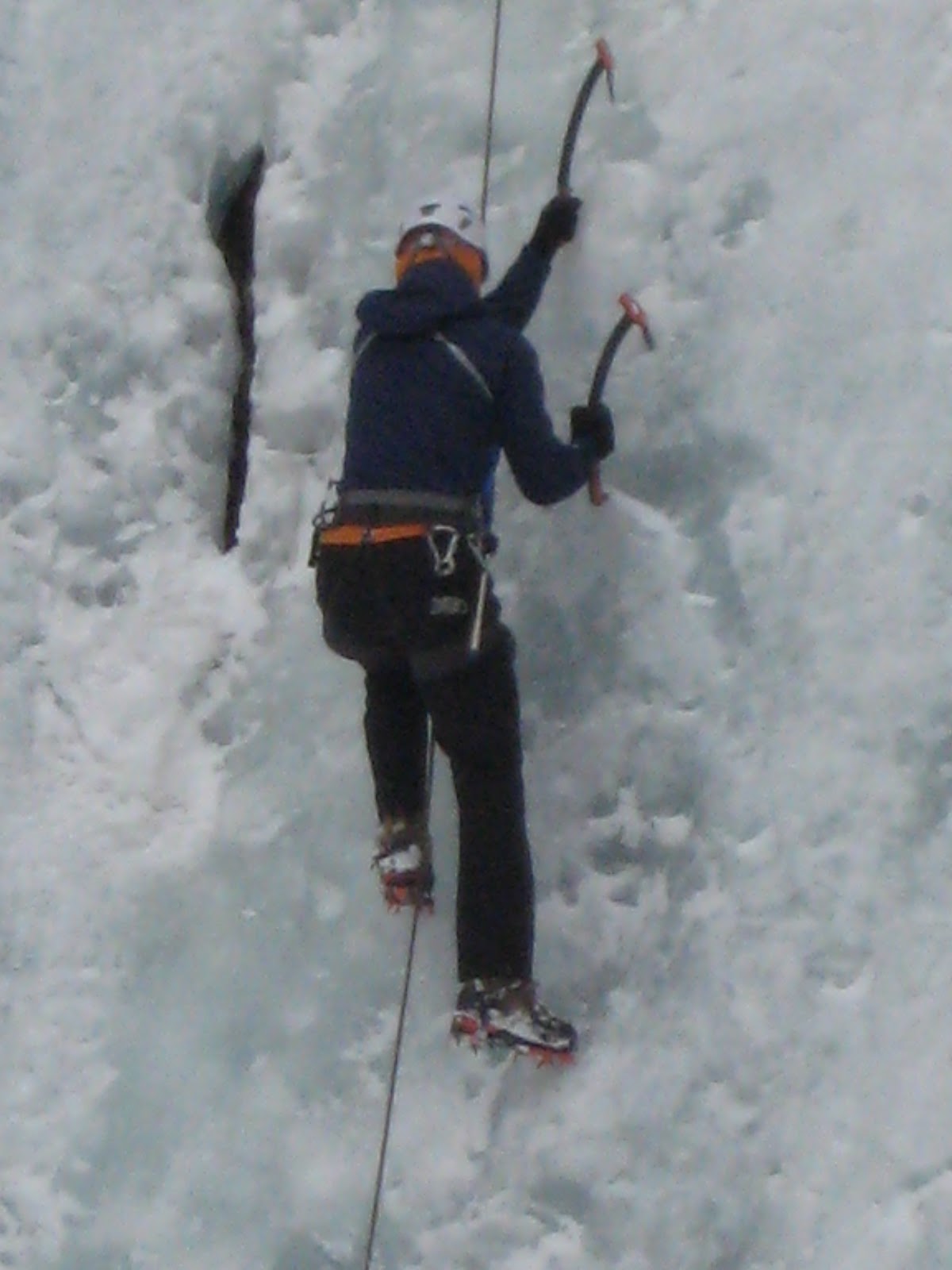
Phil and I got out this morning to do a little ice climbing. Unfortunately, warmer temperatures are in the forecast so we may be getting close to the end of the ice season here. Hope not.
Anyway, here are some pictures and a video:
I am in the red, Phil is in the blue. We fixed two lines from the top and then rope soloed so that we could get more laps in. We have been using this technique a lot this winter to do as much climbing as we can in a short amount of time. It works well, but it's made me lazy. I now almost feel like complaining when I have to belay.
The pillar that I am under is our favorite line. It's about 40 feet of 4+/5- ice. It's the best steep section on the wall. There are other steep sections, but they usually stay pretty wet, thin, and shorter.
Myself on the pillar. I'm wearing the Scarpa Phantom Guides for the first time on steep ice. They are a much higher volume boot than the others I've been using, but they lock my heels down much better. Normally I have to crank the boots really tight around the ankle to hold my heel in place, but my heels hardly moved with these and they weren't laced very tightly. So far I really like them.
Phil climbing up the pillar.
Phil finishing off the central/pillar line.
Then Kelsey hiked up for some exercise and to say hi, so she became the photographer
This is the first pitch of Malan's Waterfall in Ogden, UT. Mountain project rates this pitch as WI4+ on the right side and WI5 up the pillar. I have heard other Ogdenites (who have been known to sandbag) call the right 3+ and the pillar 4+. I think the right side feels like WI4, the pillar 4+. The pillar is dead vertical for about 40 feet. The second pitch (WI5) has been really thin all winter and today looked sketchy. A friend of mine (who is a very strong climber) got on pitch 2 yesterday but ended up retreating because the ice was thin and rotten. We decided not to test our luck.
It's definitely not Canmore, Cody, or Ouray, but we can't complain.
A couple nights ago my friend Phil and I decided that a drytooling session was in order. After a month (December) of great ice climbing in Ogden, UT, the weather turned a bit fickle and drytooling has become the best option. A few days after Christmas, the weather went from nighttime lows in the teens and low 20s to lows in the mid 30s and highs near 50 degrees. This continued for about a week and then got cold again. After four days of cold weather, Phil and I headed up to Malan's Waterfall. The skies were covered with clouds that morning and the temperatures hovered around 30 degrees F. The ice definitely looked thinner than a couple weeks previous, but we both agreed it looked thick enough to safely climb. While I was leading the lower pitch (the only pitch that was in), a refrigerator sized chunk of ice fell off one of the upper pitches and hit the top of the first pitch, about 50 feet left of where I was climbing. It shattered and sent shards (baseball-size shards) of ice at Phil and me. Once at the top of the route, I quickly belayed Phil up to me and we rapped off the route and called it a day.
First Pitch of Malan's Waterfall (WI4+ according to Mountainproject, 140ft)
I haven't been ice climbing since that day. Don't get me wrong, I wasn't scared off. I can't wait to get back on the ice! However, school has since started back up, Phil is back to work full-time (which means we will start our 3am assaults again soon), and the weather has been too warm! In order to try to stay in shape, I have been snowshoeing (still not enough snow for good backcountry skiing), doing pull-ups on hangboards and ice tools, doing push-ups and crunches, and running.
Nearing the top of Ben Lomond with Kelsey
On our way back from Lewis Peak
The primary focus of this winter has been about perfecting our systems--not only our technical systems (building anchors, transitions between pitches, etc), but also our physical bodies (though perfecting is far from what is happening to my body) and our clothing and gear systems. Perfecting one's system is critical for moving fast, light, and safe in the mountains. In the past, I have been held back from moving fast for these three reasons (one or the other, not usually all three reasons at the same time). We have a relatively big objective in mind this winter, and having our systems dialed could be the difference between success and failure.
The next few posts will focus on my clothing system and some other good options.
I just wanted to share a few thoughts about what has become one of my very favorite pieces of kit. I have owned this jacket now for almost 2 1/2 years. My initial thoughts on it when I first put it on were that the fit was perfect, the cuffs were the best I've ever seen for this type of jacket, and the price was very competitive with many of the other synthetic offerings from Patagonia, Mountain Hardwear, etc. A few days later I was using it as a belay jacket while sport climbing in Ogden, Utah (it was October), then a week or so later I used it as my active climbing layer while climbing the NW Ice Couloir on the Middle Teton. The next week I was using it as a more formal jacket while going to eat at a nice restaurant. This jacket has been one of the most versatile jackets I have ever owned.
NW Couloir, Middle Teton, WY
It was about 25 degrees Fahernheit while on the Middle Teton. The wind was blowing about 35 mph from the lower saddle until we got into the couloir and then it died down to about 15 mph. Normally these temperatures would have been a little too warm to be climbing hard in this jacket, but the wind, combined with the underarm stretch panels, made climbing in this jacket quite comfortable. It was just the right amount of insulation to not overheat while climbing, and to not freeze at the belays (though we simul-climbed the majority of the route).
Two years later and I am still smitten with this jacket. My wife was too and often stole it from me, until she got one of her own for christmas. I have taken this jacket on every climbing and backpacking trip since I got it until just a few weeks ago when my wife and I climbed the Pfeifferhorn above Little Cottonwood Canyon, UT. I have grown quite attached to this jacket and I have to admit I was a bit sad leaving it behind. In place of the atom I took the Arcteryx Acto MX Hoody and a Rab Neutrino down jacket. I figured the Rab would be a little nicer around camp (lows were in the single digits) and the Acto was new and I was anxious to try it out. I must admit I was very pleased with the Acto. Stay tuned for a full review. I need to get more climbing and hiking in it under my belt.
My wife and I on the Pfeifferhorn, UT. I am wearing the Acto MX Hoody and she is in her Atom LT Hoody.
Back to the Atom. A few reasons why I love this jacket. First of all, the fit is incredible. I am 6'2", 185 lbs., and have a short torso (18" torso length). I bought it in a medium. The sleeves are the perfect length, the hood fits nicely over my head without a helmet and very well over a helmet, and the hem drops down to about mid butt in back and a couple inches below the belt in front. The DWR was intially very good, though it has now worn off. It still repels snow, and it repelled light rain well for about the first year. With the hood over a climbing helmet, the hood pulls the front of the jacket up to my nose. This is perfect for me in cold, blowing weather, and I can easily unzip the jacket six inches to breathe easier or to dump heat.
A few of the features on this jacket include two fleece-backed handwarmer pockets and an internal zip pocket, 60g of coreloft insulation (very similar to primaloft, from what I can tell), powerstretch hardfleece underarm panels, the best cuffs on the market, and a hem drawcord.
About Coreloft: I was told by an arcteryx rep that coreloft is very similar to primaloft, except the fibers are slightly bigger in diameter. This allows Arcteryx to use a looser weave in their nylon without coreloft fibers pulling through the shell fabric. This increases the breathability of the shell. I would have thought that a looser weave would decrease the durability of the fabric, but in the two years I have been climbing in the jacket, I can't find a single snag or sign of wear. My wife, on the other hand, has had her jacket for about a month and just found a small snag. She was using an ice axe for the first time a couple weeks ago, so that may have been the culprit.
There is only one way in which Arcteryx could improve this jacket, in my opinion. And actually, I don't really think it would be an improvement in most cases. Anyway, a drawcord on the hood would allow one to cinch the hood down a little tighter around the head for windy conditions. With a helmet on, the hood is perfect. Without a helmet, the hood can let a bit of cold air in around the head and can even blow off the head. A drawcord on the hood would fix this, but I'm still not convinced it's worth the extra weight. On very cold and windy days, the powerstretch panels can get a little drafty. In this case a light wind jacket over the top is an easy solution. The benefit of the added breathability far outweighs this bad side effect.
To see this jacket in action as well as the fit and features, here's a good, short video from ogdenoutdooradventure.com: